
🚗 Why are Volkswagen EVs not called Volts-wagen?
Late to the Party 🎉 is about insights into real-world AI without the hype.

Hello internet,
I’ve been playing with Notion and productivity all day. But let’s look at machine learning for a change!
The Latest Fashion
- NASA and IBM open-sourced a foundation model for satellite data
- NYU launches an AI ethics initiative in journalism
- François Fleuret published his deep learning pocketbook
Got this from a friend? Subscribe here!
My Current Obsession
I’m still alive! I installed a bunch of switches in my flat to automate the lights and shades, and I’m really proud! Not one fuse was blown in the process, and now it all works automagically. I don’t know why but building these automations is making me unreasonably happy.
I read Marie Poulin’s newsletter that spoke about the Daily Startup Dashboard and her Daily Meeze and got completely hooked on overhauling parts of my planning and tracking templates. Hence, why I’m late. I was playing with databases all of Saturday. And again the automation. The new buttons in Notion are a delight for setting up big complex connections automatically. I love it.
Thing I Like
In addition to the internal switches I installed last week, I got a bunch of these wifi-enabled socket plugs. They can be integrated into all other automations, and they measure the usage of the devices connected to them. Super convenient for some hard-to-reach places and general awareness of your usage while pulling less than a Watt.
Machine Learning Insights
Last week I asked, What is an auto-regressive model, and what applications do you see for them?, and here’s the gist of it:
An auto-regressive model is a predictive model that uses past values of a time series to predict future values. In simpler terms, it’s a method that looks at how a variable has behaved in the past to forecast how it might behave in the future. Then applies a model to its output to forwardmodel that dependency.
Imagine you’re looking at meteorological data, specifically temperature measurements. An auto-regressive model would use the historical temperature readings over a specific time period (let’s say the past week) to predict the temperature for the next day. Patterns in temperature fluctuations over the past few days can provide insights into what the temperature might be like in the near future.
Auto-regressive models are commonly used in time series forecasting, where the data points are collected over regular intervals, such as days, months, or even minutes. Here are a couple of applications where auto-regressive models can be useful:
- Stock Price Prediction: In theory, auto-regressive models can be applied to predict stock prices. The model can make forecasts about future price movements by analysing historical stock prices and their trends.
- Energy Consumption Forecasting: In the context of energy management, auto-regressive models can help predict future energy consumption based on historical data. This is valuable for optimising energy distribution and resource allocation.
- Epidemic Outbreak Prediction: Auto-regressive models can also be used in predicting the spread of diseases. By examining past infection rates and trends, the model can offer insights into the potential course of an epidemic.
- Weather Forecasting: Returning to meteorological data, auto-regressive models are commonly used in weather forecasting. By analysing past weather patterns, these models can predict future weather conditions such as temperature, precipitation, and wind speed, as FourCastNet and GraphCast do.
- Financial Forecasting: Auto-regressive models can be applied to predict various financial metrics, such as GDP growth, inflation rates, and currency exchange rates.
The key strength of auto-regressive models is their ability to capture temporal dependencies in data. They’re particularly effective when there’s a correlation between past and future values. However, it’s important to note that their accuracy can be limited if there are sudden shifts in trends or if external factors (like sudden policy changes) significantly affect the data.
In summary, an auto-regressive model uses past values of a variable to predict its future values. These models are widely used in various applications where data is collected over time intervals, such as stock price, energy consumption, epidemic outbreak, weather, and financial forecasting. They’re effective in capturing temporal patterns and dependencies in data, making them valuable tools in predictive modelling.
Data Stories
As the current recession unfolds, I find it interesting to look at wealth inequality.
If our wealth was distributed perfectly equally, the “top 1%” would have 1% of the wealth.
But this section widens when the few hoard wealth.
So the stacked bar chart below shows how much of the total wealth in a country is held by the top 1% and 10%, respectively.
Generally already interesting how the lowest in this comparison is Greece, where the top 1% “only” hold 9% of the national wealth.
I didn’t know that in Germany, where I currently reside, over half the wealth is held by 10% of people.
What interesting things do you read from this chart? Let me know!
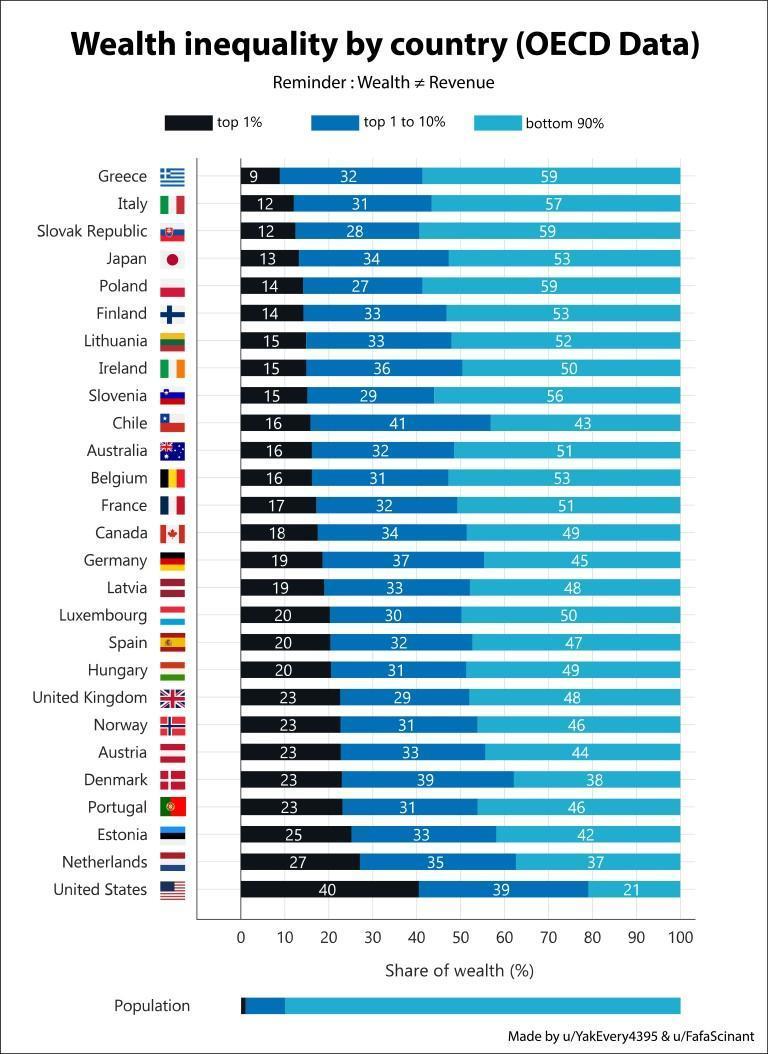
Source: YakEvery4395 and FafaScinant
Question of the Week
- What techniques or methodologies do you employ to measure and evaluate the effectiveness of different prompts in guiding the responses of language models?
Post them on Mastodon and Tag me. I’d love to see what you come up with. Then I can include them in the next issue!
Tidbits from the Web
- Critical Role is publishing a new unique Role-playing system, and their 3-ep adventure around it is amazing.
- Zoom now reserves the right to train AI on your calls…
- How police can make up the law


Add a comment: